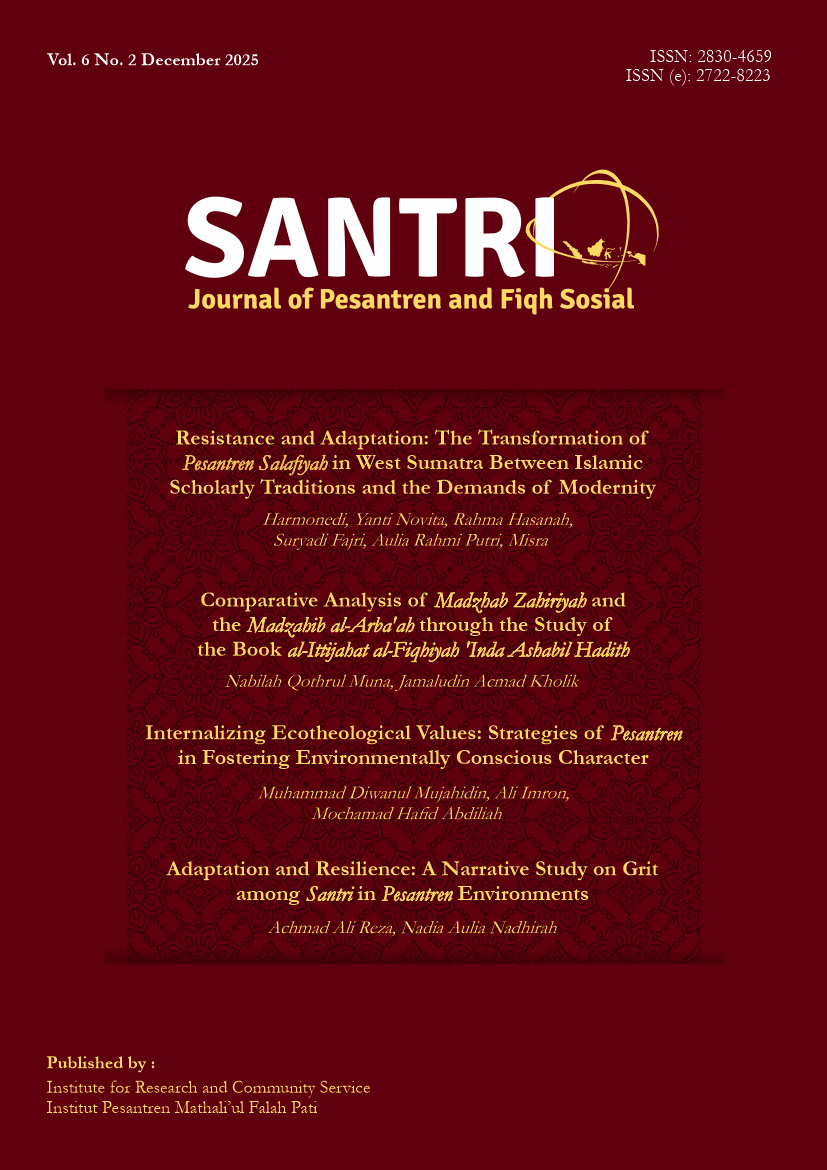
Comparative Analysis of Madzhab Zahiriyah and the Madzahib al-Arba'ah through the Study of the Book al-Ittijahat al-Fiqhiyah 'Inda Ashabil Hadith
Abstract
Madzhab Zahiriyah is more often known for its textualist approach to texts as legal ijtihad and for its rejection of the qiyas and ra’y methods. Most of its legal sources are the Qur'an and hadith, which are clearly evident. Some Madzhab also give their opinions on Madzhab Zahiriyah, and compare it to the 4th Madzhab, the Madzahib al-Arba'ah, regarding its legal istinbat. This study aims to examine the relationship between Madzhab Zahiriyah and the four Madzhabs of fiqh (Mazāhib al-Arba'ah), through the literature study research method with the primary source of the book al-Ittijahat al-Fiqhiyah 'Inda Ashhab al-Hadis fi al-Qarni ats-Tsalits, supported by other literature sources. This study examines the relationship between Madzhab Zahiriyah and the Madzāhib al-Arba'ah of fiqh, specifically regarding differences in ijtihad methodology. Although both are based on the Qur'an and Hadith as primary sources, the Madzhab Zahiriyah of thought takes a fundamentally different approach. Madzhab Zahiriyah of thought strongly rejects the use of qiyās, istihsān, and all forms of ra'y-based ijtihad, which are the primary instruments in the legal istinbāṭ methodology of the other Madzahib al-Arba’ah of thought.
Downloads
References
Fazlurrahman, M. L. (2020). Al-Imam Ibnu Hazm Wa Juhuduhu Al-’Ilmiyyah. Sophist: Jurnal Sosial Politik Kajian Islam Dan Tafsir, 2(1), 61–77. https://doi.org/10.20414/sophist.v2i1.22
Fiqh al-Ibadah al-Muqaran. (n.d.). Jami’ah al-Azhar.
Ginanjar, Y. (2004). Sanksi Hukum bagi Pelaku Pencurian antara Suami Istri Menurut Imam Asy-Syafi’i dan Ibn Hazm.
Hami, W. (2022). Tafsir Atas Poligami Melalui Pendekatan Interdisipliner. Al-Kauniyah, 3(2), 43–56. https://doi.org/10.56874/alkauniyah.v3i2.974
Hidayatulloh, H. (n.d.). Adil dalam Poligami Perspektif Ibnu Hazm.
Ibrahim, Z. (2013). Ibn Hazm: Profile of a Muslim Scholar. American Journal of Islam and Society, 30(2), i–vi. https://doi.org/10.35632/ajis.v30i2.1129
Mahmud, A. M. (1979). Al Ittijahat Al Fiqhiyah ‘Inda Ashab Al Hadis Fi Qarni Ats Tsalits. Maktabah Al Khanji.
Musadad, A. (2023). Muqaranah Madzahib: Perbandingan Madzhab Dalam Hukum Islam. PT Literasi Nusantara Abadi Group.
Shihab, Q. (2019). Islam Yang Saya Anut. Lentera Hati.
Siri, H. (n.d.). Metode Lafziyah dalam Mengistinbatkan Hukum Menurut Mazhab Zahiriyah.
Sulaiman, U. (1998). Al Madkhol Ila Dirosati Al Madarisi Wa Al Mazhabi Al Fiqhiyah. Dar An Nafais.
Tihami, M. A. (1995). Dawud Al-Dhahiri dan Aliran Al-Dhahiriya. ALQALAM, 10(52), 18. https://doi.org/10.32678/alqalam.v10i52.1514
Wangsa, F. A., & Rayyn, I. G. B. A. P. (2022). Pemikiran Ibn Hazm: Mazhab Zhahiri dan Filsafat. Jurnal Ushuluddin: Media Dialog Pemikiran Islam, 24(1), 47–57. https://doi.org/10.24252/jumdpi.v24i1.27071
Yahya, M. T., El-Sakhawy, R. M., Muthoifin, M., & Al-Mutawakkil, T. (2023). Marriages of More Than Four and its Impacts on Community Perspective of Islamic Law and Indonesian Law: تعدد الزوجات أكثر من أربع النسوة وأثارها في المجتمع عند منظور الشريعة والقانون الإندونيسي. Demak Universal Journal of Islam and Sharia, 1(02), 67–82. https://doi.org/10.61455/deujis.v1i02.8

This work is licensed under a Creative Commons Attribution-ShareAlike 4.0 International License.