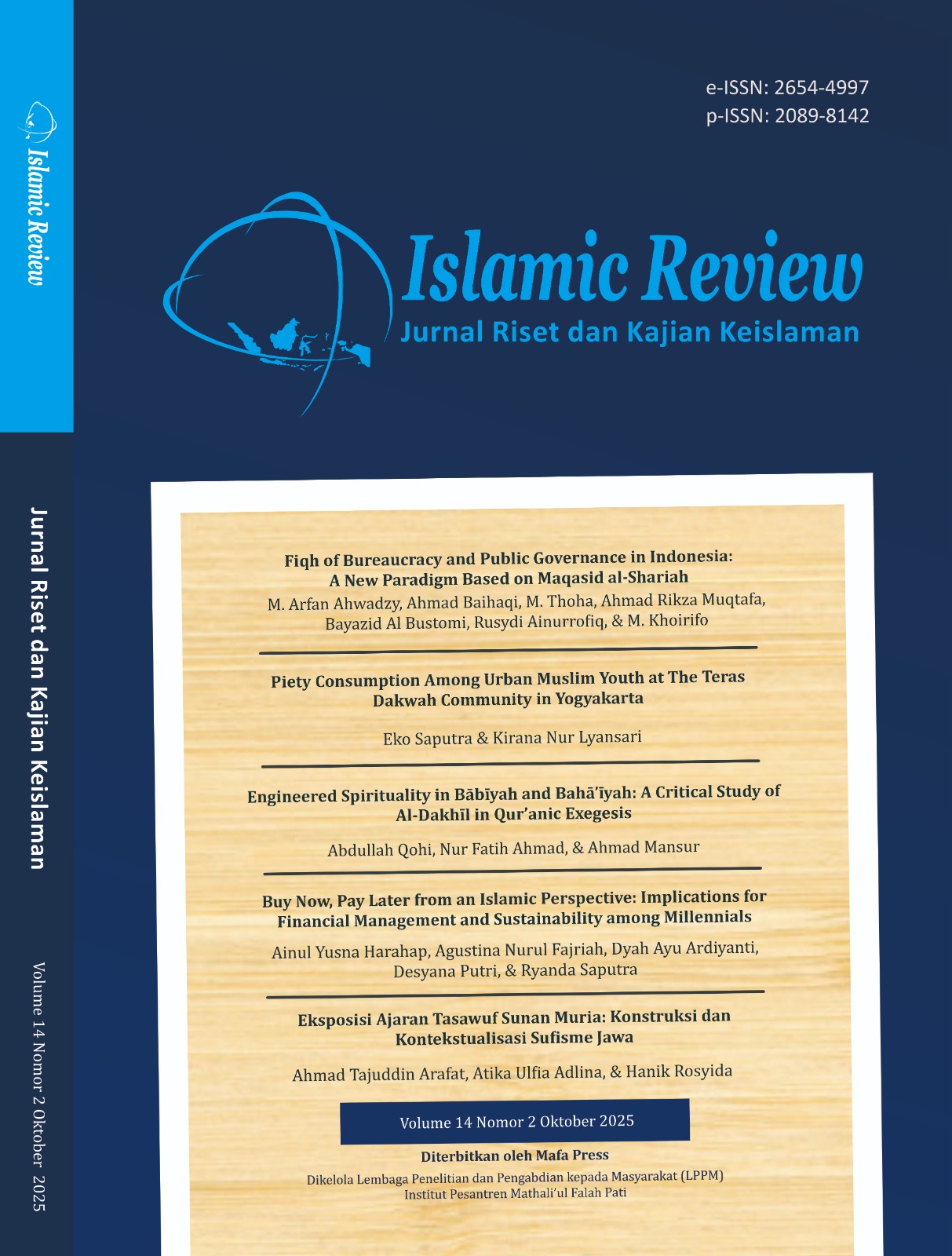
Fiqh of Bureaucracy and Public Governance in Indonesia: A New Paradigm Based on Maqasid al-Shariah
Abstract
Inefficiency in bureaucracy, corruption, and weak governance are global problems that impact societal welfare. This research introduces fikih birokrasi (bureaucratic jurisprudence) as a new concept that bridges the gap between modern public administration theory and normative Islamic law by using the maqashid syariah (objectives of Islamic law) as its foundational value. The principle of maslahah (public interest) is positioned both as an ethical norm and a practical instrument for creating governance that is just, ssustainable, and accountable. The methodology employed is a descriptive-qualitative approach, utilizing the Miles and Huberman model for analysis. The research findings indicate that fikih birokrasi contributes a practical framework for public administration based on maqashid syariah, which can be operationalized through indicators of Islamic governance. This research presents a discourse offering an alternative paradigm in bureaucracy that connects the worldly-spiritual hereafter dimension, the individual-collective aspect, and material-spiritual needs with the practical demands of modern governance.
Downloads
References
Al-Asbaḥī, Muḥammad bin Alī bin Muḥammad. Badā’i as-Sulk Fī Ṭabā’i al-Mulk. Wizārah al-I’lām, 1431.
Al-Būṭī, Saʻīd Ramaḍān. Dawābit Al-Maṣlaḥah Fī al-Syarī‘ah al-Islāmiyyah. Mu’assasah al-Risālah, 1992.
Alfian, Endang Larasati Setianingsih, Kismartini, and Tri Yuniningsih. “Islamic Bureaucracy in the Philosophy of Public Administration: A Narrative Literature Review.” Open Access Indonesia Journal of Social Sciences 5, no. 6 (2022): 6. https://doi.org/10.37275/oaijss.v5i6.139.
Al-Māwardī, Abū al-Ḥasan ʿAlī bin Muḥammad bin Muḥammad bin Ḥabīb al-Baṣrī al-Baghdādī. Al-Aḥkām as-Sulṭāniyyah Fī Wilāyah Ad-Dīniyyah. Edited by Aḥmad Jād. Dār al-Hadīs, 2015.
Al-Miṣrī, Zainuddīn Ibn Nujaīm Al-Ḥanafī. Al-Baḥr Ar-Rāiq Syarḥ Kanz Ad-Daqāiq. Dār al-Kitāb al-Islāmi, 1431.
Al-Muzjājī, Aḥmad bin Dāwūd Al-Asy’arī. Muqaddimah Fī Al-Idārah al-Islāmiyyah. Al-Mamlakah al-‘Arabiyyah as-Sa’ūdiyyah, 2000.
Anwar, Syamsul. “Membangun Good Governance Dalam Penyelenggaraan Birokrasi Publik Di Indonesia: Tinjauan Dari Perspektif Syari’ah Dengan Pendekatan Ilmu Usul Fikih.” (Yogyakarta), UIN Sunan Kalijaga, 2005.
As-Shiddiqi, Hasbi. Islam Menjawab Tantangan Zaman. Bulan Bintang, 1966.
As-Subkī, Tāj ad-Dīn ‘Abd al-Wahhāb bin Taq ad-Dīn. Mu’īd an-Ni’am Wa Mubīd an-Niqam. Muassasah al-Kutub as-Saqāfiyyah, 1986.
As-Syarīf, Muhammad Syākir. Idārah Ad-Daulah al-Islāmiyyah. Majallah al-Bayān, 1434.
As-Syāṭibi, Abu Ishāq Ibrāhīm bin Mūsā. Al-Muwāfaqāt. Dār Ibn Affān, 1997.
Auda, Jasser. Maqasid Al-Shariah as Philosophy of Islamic Law: A Systems Approach. International Institute of Islamic Thought (IIIT), 2008.
Az-Zuḥailī, Wahbah. Uṣūl Al-Fiqh al-Islāmī. Dār al-Fikr, 2006.
Bakti, Andi Faisal. “Good Governance Dalam Islam: Gagasan Dan Pengalaman.” In Islam, Negara Dan Civil Society: Gerakan Dan Pemikiran Islam Kontemporer, edited by Komaruddin Hidayat and Ahmad Gaus. Paramadina, 2005.
Bashori, Akmal. Fikih Nusantara: Dimensi Keilmuan Dan Pengembangannya. Kencana, 2021.
Costa, Dennis Souza da, and Ivana Siqueira Teixeira. “The Action of Centripetal and Centrifugal Forces in Religious Discourse about People with Disabilities: Reflections Based on Bakhtin and the Circle.” Bakhtiniana: Revista de Estudos Do Discurso 19 (2024): e63573p. https://doi.org/10.1590/2176-4573e63573.
Fatmawati, Dewi, Noraini Mohd. Ariffin, Nor Hafizah Zainal Abidin, and Ahmad Zamri Osman. “Shariah Governance in Islamic Banks: Practices, Practitioners and Praxis.” Global Finance Journal 51 (February 2022): 100555. https://doi.org/10.1016/j.gfj.2020.100555.
Feramahdalena, Elsa, Angga Rosidin, Heru Wahyudi, and Jaka Maulana. “Penguatan Etika Islam Dalam Birokrasi Di Banten.” ANTASENA: Governance and Innovation Journal 3, no. 1 (2025): 29–39. https://doi.org/10.61332/antasena.v3i1.292.
Firmansyah, Firmansyah, Miftahul Husni, Ade Rosad, Muhammad Iqbal Al Ghozali, and Gatot Kaca. “Islamic Ethics and Morality in the Educational Bureaucracy: Theoretical and Practical Review.” INCARE, International Journal of Educational Resources 5, no. 5 (2025): 559–74. https://doi.org/10.59689/incare.v5i5.1137.
Fuad, Mahsun. Hukum Islam Indonesia: dari nalar partisipatoris hingga emansipatoris. LKiS, 2005.
Harisudin, M Noor. Fiqh Nusantara: Pancasila Dan Sistem Hukum Nasional Indonesia. Pustaka Compass, 2019.
Harisudin, M. Noor. Membumikan Islam Nusantara. Pena Salsabila, 2016.
Haruna, Sanusi Lafiagi. “Islamic Civilization’s Contributions to Modern Governance.” Jurnal Penelitian Dan Pengembangan Sains Dan Humaniora 8, no. 1 (2024): 1. https://doi.org/10.23887/jppsh.v8i1.81551.
Hidayat, Achmad, and Zaenal Arifin. “Narasi Fikih Kebangsaan Di Pesantren Lirboyo.” Intelektual: Jurnal Pendidikan Dan Studi Keislaman 10, no. 3 (2020): 3. https://doi.org/10.33367/ji.v10i3.1491.
Ibn Kaṡīr, Abū al-Fidā Ismāīl bin Umar. Al-Bidāyah Wa an-Nihāyah. Dār al-Hajr, 2003.
Indira, Gianni, Erlina Sari Piliang, and Zahratul Husna. “Penguatan Karakter Etika Islam Dalam Birokrasi.” YUDABBIRU JURNAL ADMINISTRASI NEGARA 5, no. 1 (2023): 1. https://ejournal.uniks.ac.id/index.php/YUDABBIRU/article/view/2630.
Iskandar, Indra, and Hamdan Azhar Siregar. “The Prosecutor’s Authority to Conduct Investigations into Corruption Crimes Causing State Financial Losses (Case Study in PT. Timah Tbk).” Law Development Journal 7, no. 3 (2025): 392–402. https://doi.org/10.30659/ldj.7.3.392-402.
Jahar, Asep Saepudin. “Bureaucratizing Sharia in Modern Indonesia: The Case of Zakat, Waqf and Family Law.” Studia Islamika 26, no. 2 (2019): 2. https://doi.org/10.15408/sdi.v26i2.7797.
Jenkin-Smith, Daniel. “A Tale of Two Bureaucracies: The Formal Development of Mid-Nineteenth-Century French and British Office Novels.” Nineteenth-Century Literature 77, nos. 2–3 (2022): 93–123. https://doi.org/10.1525/ncl.2022.77.2-3.93.
Joukovskaia, Anna. “Bureaucracy: The Making of a Buzzword.” Journal of the History of Ideas 84, no. 4 (2023): 685–710. https://muse.jhu.edu/pub/56/article/909535.
Jugl, Marlene. “Patterns of Bureaucracy: Conceptualizing Administrative Traditions.” Journal of Public Administration Research and Theory 35, no. 3 (2025): 277–91. https://doi.org/10.1093/jopart/muaf012.
Kementerian Agama RI. “Survei Litbang Kemenag, Indeks Kesalehan Sosial 82,59 dan Indeks Kepuasan Layanan KUA 83,237.” With Moh Khoeron. https://kemenag.go.id, 2023. https://kemenag.go.id/nasional/survei-litbang-kemenag-indeks-kesalehan-sosial-82-59-dan-indeks-kepuasan-layanan-kua-83-237-FZe6N.
Khallāf, Abdul Wahhāb. As-Siyāsah As-Syar’iyyah Fī Syu’ūn Ad-Dustūriyyah Wa Al-Khārijiyyah Wa Al-Māliyah. Al-Maṭba’ah As-Salafiyyah, 1935.
Khasanah, Nur. “Kesalehan Birokrasi Dalam Perspektif Al-Qur’an (Kajian Tafsir Fi Zhilal al-Qur’an).” Skripsi Sarjana, Institut Ilmu Al-Qur’an (IIQ) Jakarta, 2016.
Napitupulu, Rodame Monitorir, Raditya Sukmana, and Aam Slamet Rusydiana. “Governance of Islamic Social Finance: Learnings from Existing Literature.” International Journal of Islamic and Middle Eastern Finance and Management 17, no. 3 (2024): 552–71. https://doi.org/10.1108/IMEFM-06-2023-0222.
Ombudsman Republik Indonesia. “Data.Ombudsman.Go.Id/Ombudsman-Republik-Indonesia/Persentase-Dugaan-Maladministrasi-Dalam-Penyelenggaraan-Pelayanan-Publik-Menurut-Jenis.” Persentase Dugaan Maladministrasi Dalam Penyelenggaraan Pelayanan Publik Menurut Jenis. Accessed August 13, 2025. https://data.ombudsman.go.id/ombudsman-republik-indonesia/persentase-dugaan-maladministrasi-dalam-penyelenggaraan-pelayanan-publik-menurut-jenis.
Pearson, Lisa, Loretta Bradley, and Stephen Southern. “Religious and Counseling Discourses in Clinical Practice.” The Family Journal 32, no. 3 (2024): 326–34. https://doi.org/10.1177/10664807241242568.
Rahmat, Basuki, Beni Hartanto, and Acep Hilman. “Bureaucratic Reform in Indonesia: From “Public Administration" to ‘Public Management.’” Journal of Local Government Issues 7, no. 2 (2024): 144–58. https://doi.org/10.22219/logos.v7i2.33848.
Riska, Nafila, Nur Niesa Farhana, Maghfirah, Naura Amalia, Najwa Shafira, and Nurul Syifa. “Etika Profesi Dalam Perspektif Islam: Analisis Konseptual Terhadap Pencegahan Korupsi Di Kalangan ASN.” Scientific Journal for Nation Building 1, no. 1 (2025): 1. https://ejournal.ynam.or.id/index.php/jn/article/view/45.
Rizki, Muhammad Aditia. “Sharia-Based Public Service Administration in Aceh: A Normative-Conceptual Study from an Islamic Perspective.” AJIL: Aceh Journal of Islamic Law 2, no. 1 (2025): 33–52. https://journal.iainlangsa.ac.id/index.php/ajil.
Rusydi, Ibnu. “Good Governance According To Islamic Perspective.” Munaddhomah: Jurnal Manajemen Pendidikan Islam 4, no. 4 (2023): 1001–7. https://doi.org/10.31538/munaddhomah.v4i4.727.
Ṣābit, Muḥammad Khālid. Rijāl Ḥaul Ar-Rasūl. Dār Al-Fikr, 2000.
Sahal, Akhmad, and Munawir Aziz, eds. Islam Nusantara: Dari Ushul Fiqh Hingga Paham Kebangsaan. Mizan Pustaka, 2015.
Shiddiqi, Nourouzzaman. Fiqh Indonesia: penggagas dan gagasannya. Pustaka Pelajar, 1997.
Solikhudin, Muhammad, and Moh Zainullah. “The Formulation of Good Governance Fiqh for Indonesia as a Welfare State.” Al-Qisthu: Jurnal Kajian Ilmu-Ilmu Hukum 20, no. 2 (2022): 166–81. https://doi.org/10.32694/qst.v20i2.1718.
Supono, and Mukti Fajar Nur Dewata. “Kontribusi Hukum Islam Terhadap Reformasi Birokrasi: Upaya Peningkatan Kualitas Pelayanan Publik Yang Efisien, Efektif, Dan Berkualitas.” Jurnal Esensi Hukum 6, no. 1 (2024): 1. https://doi.org/10.35586/jsh.v6i1.322.
Turner, Mark, Eko Prasojo, and Rudiarto Sumarwono. “The Challenge of Reforming Big Bureaucracy in Indonesia.” Policy Studies 43, no. 2 (2022): 333–51. https://doi.org/10.1080/01442872.2019.1708301.
Yunus, Nur Rohim. “Menciptakan Good and Clean Government Berbasis Syariah Islamiyah Dalam Tatakelola Pemerintahan Republik Indonesia.” Nur El-Islam 3, no. 1 (2016): 143–75. https://www.neliti.com/publications/226465/.
Yustia, Dewi Asri, and Firdaus Arifin. “Bureaucratic Reform as an Effort to Prevent Corruption in Indonesia.” Cogent Social Sciences 9, no. 1 (2023): 2166196. https://doi.org/10.1080/23311886.2023.2166196.
Zarkasyi, Jaja. Di Balik Meja Birokrat: Fikih Islam Tentang Layanan Publik. Gramedia, 2023.

This work is licensed under a Creative Commons Attribution-ShareAlike 4.0 International License.
Pemberitahuan Hak Cipta
Penulis yang menerbitkan bersama Islamic Review: Jurnal Riset dan Kajian Keislaman menyetujui ketentuan berikut:
- Penulis mempertahankan hak cipta dan memberikan jurnal hak publikasi pertama dengan karya yang dilisensikan secara bersamaan di bawah Lisensi Creative Commons Attribution-ShareAlike 4.0 International License (CC BY-SA 4.0) yang memungkinkan orang lain untuk berbagi karya dengan pengakuan kepenulisan karya dan publikasi awal dalam jurnal ini.
- Penulis dapat membuat pengaturan kontrak tambahan yang terpisah untuk distribusi non-eksklusif dari versi jurnal yang diterbitkan dari karya tersebut (misalnya, mempostingnya ke repositori institusi atau menerbitkannya dalam sebuah buku), dengan pengakuan awal publikasi di jurnal ini.
- Penulis diizinkan dan didorong untuk memposting karya mereka secara online (misalnya, di repositori institusional atau di situs web mereka) sebelum dan selama proses pengiriman, karena dapat menghasilkan pertukaran yang produktif, serta kutipan lebih awal dan lebih besar dari karya yang diterbitkan.

Karya ini dilisensikan di bawah Creative Commons Attribution-ShareAlike 4.0 International License.